

Is there a strong business reason to invest in menstrual health programs and inclusive workplace policies? Yes. More organizations are seeing that menstrual health is a real workplace issue that affects employee well-being, inclusion, and day-to-day participation.
When employees don’t have period products, supportive policies, or a workplace where they can talk about it without shame, it can affect attendance, focus, and performance. This is not just a health topic; it is also a business priority that can affect costs and results.
Learning how the menstrual cycle works can also help both employees and employers better understand health and productivity patterns. For more detail, see https://cyclicalschool.com/menstrual-cycle/.
The Business Imperative for Menstrual Health Programs and Inclusive Workplace Policies
Why Menstrual Health Matters to Businesses
The workforce is changing, and women make up close to half of it, so their health needs cannot be ignored. Many employees who menstruate deal with symptoms like cramps, headaches, mood changes, and tiredness. These can affect comfort, concentration, and daily work. If the workplace is not set up to support these needs, employees may have to improvise, step away from work, or push through pain. This leads to avoidable interruptions and lower output.
When menstrual health is ignored, the impact does not go away. It simply lands on the employee and their team. This often shows up as “presenteeism,” meaning someone is at work but not well, so their work is slower or lower quality. Recognizing menstrual health and offering support is not just a “nice thing to do.” It is part of building a modern workplace that runs well and treats people fairly.
Linking Employee Well-being and Organizational Success
Employee well-being and business success are closely connected. When people feel their health needs are understood and supported, they are more likely to stay engaged, work well, and remain with the company. When menstrual health is overlooked, morale can drop, absences can rise, and the workplace can feel less welcoming. Research shows this clearly: a global survey by the Healthcare Businesswomen’s Association (HBA) and FemTechnology found that 70% of women employees lose one to five days of productivity each month because of women’s health issues, but only 10% feel their employer supports them well. That gap is a clear chance for employers to improve.
The Deloitte Women @ Work report (2024) reports similar findings. Half of women surveyed said their stress levels increased, and many deal with pain, discomfort, or emotional strain without telling anyone. When there is no open conversation or clear policy, women carry this burden alone, which can affect their output and career growth. Supporting these needs gives businesses a practical way to improve overall results.
What Are Menstrual Health Programs in the Workplace?
Types of Menstrual Health Support Initiatives
Menstrual health programs at work include actions that support employees across many life stages, from the first period through menopause. These programs go beyond simple “special requests” and aim to create understanding and steady support. They can include free period products, flexible work options, paid menstrual leave, and education materials. Essity, a global hygiene and health company, is one example. It includes menstrual health in its well-being approach, provides free products in bathrooms, and runs efforts to make it easier to talk about menstruation and menopause.
These actions are also about changing workplace culture. Flexible options like working from home or adjusting hours can help employees manage symptoms without fear of punishment or embarrassment. Paid menstrual leave is not common everywhere, but it is growing as an idea. It gives time off for severe symptoms or medical care, such as policies tested by forward-looking employers and in places like the Indian state of Kerala.
Menstrual Hygiene Management (MHM): Key Features and Practices
Menstrual Hygiene Management (MHM) at work means giving employees the tools and space to manage periods safely, cleanly, and with respect. A key part of MHM is making menstrual products available in workplace restrooms. This may sound small, but it can be one of the cheapest changes with the biggest effect. Having clearly marked dispensers or baskets with pads, tampons, and other options supports privacy, reduces disruption, and helps employees feel respected.
The benefits are easy to see: research shows 62% of menstruators have left work to buy supplies, 53% have borrowed products, and 34% have gone home to get them. All of these cause delays and interruptions. Providing products at work reduces these issues. The average yearly cost is about $6 per employee. For an employer with 50 female employees, this can produce an ROI of at least 287% in the first year, with returns growing as setup costs are spread out. That makes MHM both a people-focused step and a smart money decision.

Addressing Stigma and Fostering Open Communication
Supplies matter, but programs also need to deal with stigma and make it easier to talk. Menstruation has long been treated as a taboo topic at work, which pushes people to manage it quietly and alone. Training and education can lower shame and help people speak more openly.
Workshops, simple handouts, or short talks can teach all employees-men and women-about menstrual health, common symptoms, and what support the company offers. This helps people see menstruation as a normal body process, not something “inappropriate.” When leaders and managers support open discussion and address discrimination or awkward behavior, it helps build a workplace where people feel safe and respected. As Essity and UNFPA suggest, a “menstrual health in all policies” approach places this thinking into everyday work, so awareness becomes real support.
Key Benefits of Supporting Menstrual Health in the Workplace
Improves Gender Equality and Diversity
Supporting menstrual health directly supports gender equality and helps workplaces become more diverse. UN Women’s Women’s Empowerment Principles (WEPs), especially Principle 3, calls on companies to support the health, safety, and well-being of all employees, with attention to women’s needs. If menstrual health, reproductive care, and menopause are ignored, it keeps inequality in place and makes it harder for women to fully take part and grow at work.
When companies act on these needs, they show they want a fair workplace where people are supported in real ways. This reduces barriers that have held women back and helps create a workforce that better reflects society. More diversity is also linked to better ideas and stronger business results.

Improves Organizational Reputation
Many people now judge organizations by their values and how they treat employees. Companies that take menstrual health seriously can stand out as caring and modern employers. This is supported by data: early findings from the Period Positive Workplace (PPW) initiative show that 75% of managers involved saw better public perception after adopting period-positive policies.
Visible support builds trust inside and outside the company. It can help attract job candidates who want a supportive workplace, and it can also improve how customers and partners view the organization, especially as more people prefer businesses that act responsibly.
Boosts Employee Satisfaction and Mental Health
Menstrual health support can strongly affect job satisfaction and mental health. When employees have resources and flexibility to manage periods, they often feel more valued. In the PPW survey, 87% of managers reported better employee satisfaction after joining the initiative. Feeling supported can lower stress and anxiety and improve overall mental well-being.
Many women work through pain or emotional strain without saying anything. When a company makes it normal to discuss these needs and offers practical options, it reduces the mental load many employees carry. This helps build a culture where people feel safer, more respected, and more willing to stay engaged in their work.
Delivers Measurable Business Returns: Data and Case Studies
Menstrual health programs are not only about fairness; they also bring measurable returns. Providing period products is a low ongoing cost with a strong payoff. RMH Compass notes that for an employer with 50 female employees, offering period products can produce an ROI of at least 287% in the first year, driven by fewer interruptions and a better employee experience.
UNFPA’s Coalition for Reproductive Justice in Business created an ROI tool showing broader effects. Companies that invest in sexual and reproductive health and rights (SRHR) programs, including menstrual health, could see up to a 62% drop in absenteeism and a 22% rise in productivity. These programs can also improve engagement and reduce turnover. The numbers show that menstrual health support is a practical investment with clear business value.
How Inclusive Workplace Policies Impact Productivity and Engagement
Sick Leave, Reproductive Health, and Menstrual Leave Policies
Inclusive workplace policies-especially around sick leave, reproductive health, and menstrual leave-support productivity and engagement. Many companies offer paid sick leave, but the policy may not clearly say that menstrual symptoms are covered. When companies make this clear, employees can take time when needed without feeling embarrassed or unsure.
Some employers and regions also use dedicated menstrual leave. Kerala, India, tested a policy of two days of paid leave per month for menstrual health issues, and it has been received well by employees and employers. Companies like Mejuri have also added benefits such as “no questions asked” time off and travel reimbursement for healthcare, helping employees keep access to reproductive care during changing legal situations. Clear policies reduce confusion for employees and managers and lower stress.
Reducing Absenteeism and Presenteeism
Supportive menstrual health policies can reduce absenteeism and presenteeism. Presenteeism-coming to work while unwell-drains productivity. Research shows 80.7% of women have experienced presenteeism linked to menstrual symptoms like pain, fatigue, or migraines. This lowers individual performance and can also affect team output and work quality.
Lack of supplies also causes disruption. Many menstruators leave work, borrow products, or go home to get them. When businesses provide free products in restrooms, employees can handle needs quickly and privately, which helps them stay focused and productive during the day.
Effects on Employee Retention and Talent Attraction
In a competitive job market, inclusive policies help keep employees and attract new talent. Companies that show real care for employee well-being often build trust and loyalty, which supports long-term value. Mejuri, a women-founded Canadian jewelry company with a 78% female workforce, notes that company values strongly affect retention, especially for newer employees.
Many employees today want more than basic healthcare. They want steady access to reproductive care and clear support. Businesses that meet these expectations are more appealing to skilled candidates. By investing in menstrual health programs, employers can keep experienced people and also become a stronger choice for diverse talent.
Challenges and Barriers to Implementation
Overcoming Taboos and Organizational Resistance
Even with clear benefits, menstrual health programs can be hard to put in place because of taboos and internal pushback. For a long time, menstruation has been treated as something that should not be discussed in public or at work. This stigma can make it hard to start the topic, and even harder to add policies. Some leaders may see it as a narrow “women’s issue” instead of a workplace issue that affects productivity and well-being.
Changing this takes steady work on workplace culture. It means challenging old views, educating everyone (including men and senior leaders), and supporting open discussion. Without leadership support and a clear message that this matters, efforts can feel like small one-off actions instead of real change, which limits impact.
Cost Considerations and Resource Allocation
Another barrier is the worry about cost and how to fund new efforts. Even though data shows strong returns, some employers hesitate at the first cost of free products or new leave options. Smaller businesses may especially worry about budgets.
But RMH Compass data shows the yearly cost of products is usually small and can be outweighed by gains from fewer absences and better productivity. The main challenge is helping decision-makers see it as an investment, not an extra expense. Resources also include people’s time: HR and managers need time to build, run, and review programs well.
Policy Adoption in Different Cultural and Legal Contexts
Menstrual health policies can also be harder to adopt because culture and laws differ by country and region. What is normal or required in one place may be sensitive or complicated in another. Rosy Blue, an Indian diamond manufacturer, works in male-heavy settings in India and uses data-based and culturally aware approaches to support women’s well-being.
Laws also change over time. Courts are starting to recognize conditions like endometriosis and severe menstrual disorders in workplace accommodation cases, which increases employer responsibility. International guidance is also growing, including the upcoming ISO 45010 standard on menstruation, menstrual health, and menopause at work. Working across these differences takes careful planning and strategies that fit the local setting.
How to Develop and Implement Effective Menstrual Health Policies
Assessing Workplace Needs and Setting Objectives
To build effective menstrual health policies, start by checking what your workplace actually needs. One-size-fits-all fixes rarely work, so it helps to learn what employees face and what support they prefer. Anonymous surveys, focus groups, and interviews can provide useful input. Mejuri uses monthly surveys and gets a 78% response rate, helping them stay close to employee needs. This kind of feedback helps companies build policies based on real issues, not guesses.
After needs are clear, set simple, measurable goals. For example: reduce menstrual health-related absences by a set amount, raise employee satisfaction scores, or increase awareness and comfort talking about menstruation. Clear goals make it easier to track progress and keep the work focused.
Stakeholder Engagement and Internal Advocacy
Putting policies into practice depends on strong support from key people. Senior leadership support matters most. UNFPA notes that leadership backing spreads across the company, turning women’s health from “just HR” into a real business priority. That message helps employees take the policy seriously and trust it.
It also helps to involve many groups: men, line managers, HR, and employees who menstruate. Education efforts like those supported by USAID WASHPaLS, which involved men in Nepal and Kenya, show that broad involvement can build understanding and support across the workforce. Internal champions and clear ways to share feedback help keep communication open and improve programs over time.
Best Practices in Policy Design and Rollout
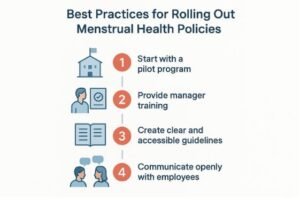
Good policy design should be clear, easy to access, and focused on people. Write short, direct guidelines that employees can easily find and understand. Make the process for requesting support simple. Manager and HR training is also important so they can respond in a respectful, practical way without judgment. Training should focus on empathy and what actions managers can take.
A step-by-step approach can work well: start small, learn, then expand. Mejuri began with “no-questions-asked” time off and later added travel reimbursement for healthcare access. This helps avoid costly mistakes from rolling out big programs too fast. Regular communication also matters so employees know what help is available and how to use it.
Measurement, Evaluation, and Continuous Improvement
Policy work continues after launch. Track how well the policies work by watching metrics like retention, diversity, and benefit use. Keep collecting employee feedback through surveys, suggestion boxes, and conversations. This helps you see what works and what needs updates.
Review how policies affect business results such as morale, absenteeism, and productivity. Mejuri shares updates twice a year on its website and through marketing, showing transparency and accountability. By reviewing results and updating policies based on real data and employee input, companies can keep menstrual health programs useful and supportive over time.
Recommended Resources and Further Reading
Learning Briefs and Guidance Documents
Organizations that want to learn more can use several practical resources. The USAID WASHPaLS project has published learning briefs such as “MHM in the Workplace: Activity Overview,” which describes partner workplaces in Nepal and Kenya, and “Cost-Benefit Analysis of MHM in the Workplace,” which explains methods and findings. Other briefs like “MHM in the Workplace: Learnings from Kenya” and “MHM in the Workplace: Overall Learnings” share country-level and overall lessons.
RMH Compass also shares helpful guidance, including “Putting It Into Practice: Enhancing Sick Leave Policies to Support Reproductive & Maternal Health.” It includes practical tips and sample wording employers can use to update sick leave policies and better support employees managing menstrual symptoms at work. These resources help organizations move from awareness to real action. Those looking to build lasting in-house expertise can also explore Cyclical School, which offers internationally recognized menstrual cycle coaching certifications designed to empower practitioners and educators worldwide.
Reports, Webinars, and Conferences
Keeping up with new research and examples helps companies make better choices. Key reports include the Deloitte Women @ Work report (2024) and the global HBA/FemTechnology survey, which offer data on women’s health at work. UNFPA’s Coalition for Reproductive Justice in Business also offers an ROI tool that estimates the benefits of SRHR programs, including menstrual health, such as fewer absences and higher productivity.
Webinars and conferences can also help people learn from others. Past events such as the UN Women WEPs webinar series and sessions at the UNC Water & Health Conference have covered topics like measuring menstrual health at work and engaging men to improve workplace menstrual hygiene and health. These events support shared learning and highlight what has worked in different settings.
Support Networks and Advocacy Groups
Organizations do not have to do this work alone. Many support networks and advocacy groups focus on menstrual health and inclusion. Groups such as UNFPA, Essity, and Days for Girls (DfG) work to reduce barriers and support menstrual equity. DfG’s Period Positive Workplace initiative has certified 173 workplaces across 40 countries and offers a structure and community for organizations committed to improvement.
RMH Compass is another helpful source, offering tools like a free ROI calculator for period products and other direct support. Working with these groups, joining initiatives, and using their tools can help companies build and run menstrual health programs that make workplaces more inclusive and supportive worldwide.