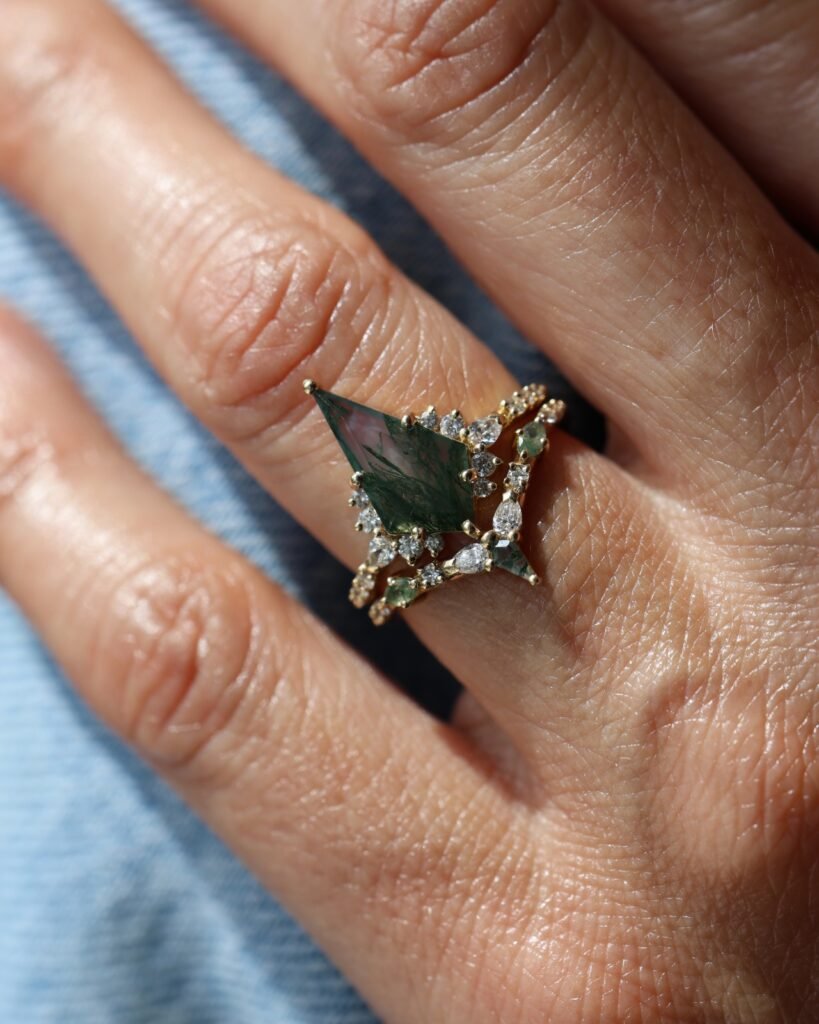

Maybe you have a photograph of a ring you like but want a different gemstone. Maybe you want to combine details from several designs. Or perhaps the only thing you know is that the finished piece should feel personal and unlike anything you’ve found in a store.
From that first idea to the moment the finished jewelry arrives, custom jewelry goes through several stages involving design decisions, gemstone selection, technical planning, production, stone setting, and finishing.
Here’s how the process typically works.
What Is Custom Jewelry?
Custom jewelry is made or modified around a customer’s preferences instead of being purchased exactly as it comes from a standard collection.
How much you can customize depends on the jeweler. Some brands let you change a few details on an existing design, while others can create a completely new piece from scratch.
You might be able to choose the gemstone, stone shape and size, precious metal, ring setting, band proportions, accent stones, engraving, or other decorative details. This can be especially helpful when you’re looking for an engagement ring but can’t quite find the right combination in a ready made design.
Fully bespoke jewelry takes it a step further. Instead of modifying an existing ring, the jeweler creates a new design specifically around your ideas and preferences.
Step 1: The Initial Idea and Consultation
Every custom jewelry piece starts with figuring out what the customer actually wants. And no, you don’t need to show up with a perfect drawing or a fully planned design.
You can bring inspiration photos, screenshots, pieces of jewelry you already own, rough sketches, gemstone ideas, a budget, or even just a general description of the style you’re looking for. Sometimes knowing what you don’t like is just as helpful.
For an engagement ring, a jeweler may also ask about your lifestyle, preferred metal, ring size, and whether you want the ring to sit comfortably next to a future wedding band.
These details might seem small, but they help the jeweler turn a general idea into a custom ring that actually works for everyday wear.
Step 2: Establishing the Budget
It’s worth talking about your budget early in the custom jewelry process because it can affect almost every design decision that comes after it.
The price of a custom piece can depend on the type and quality of the gemstone, carat weight, precious metal, how much metal the design requires, the number of accent stones, how complicated the design is, the production method, and the amount of labor involved.
A good jeweler shouldn’t just try to turn your idea into the most expensive version possible. Instead, they should help you figure out where your budget makes the most sense, whether that’s putting more toward the center stone, choosing a different metal, or simplifying certain details without losing the overall look you wanted.
Step 3: Choosing the Gemstone
For a lot of custom rings, the center stone is where the design starts. You might go with a diamond, or choose a colored gemstone like sapphire, emerald, alexandrite, opal, tourmaline, or moss agate.
When choosing a stone, your jeweler may look at its shape, dimensions, carat weight, color, clarity, cut, durability, and natural variations. These details can all affect how the finished ring looks and how well the stone works with the design.
This is especially important with gemstones that have a lot of variation from one stone to another. An opal, parti sapphire, salt and pepper diamond, or moss agate can look completely different from another stone of the same type.
Because of that, sometimes the best approach is to choose the gemstone first and design the ring around the stone rather than trying to make a particular stone fit a predetermined design.
For independent educational information about gemstones and their characteristics, the Gemological Institute of America (GIA) provides useful consumer resources.
Step 4: Selecting the Precious Metal
Once the general design and gemstone direction are established, the next decision is usually the metal.
Common choices include:
- 14k yellow gold
- 14k white gold
- 14k rose gold
- 18k gold
- Platinum
Metal choice affects more than color.
It can influence durability, maintenance, weight, price, and how the gemstone appears within the finished design.
Yellow gold, for example, creates a different visual relationship with a green emerald than white gold or platinum.
The right choice depends on the design and the wearer’s preferences.
Step 5: Creating the Design
This is where your custom jewelry idea starts to become an actual design.
Depending on the jeweler and how the piece will be made, this part of the process might involve sketches, technical drawings, CAD design, or a combination of all three. The designer works out details like where the stones will sit, the setting height, band width, ring profile, prong placement, accent stones, decorative details, and overall proportions.
It’s also where the design has to make sense beyond just looking good on paper. A ring might look great in a sketch but need a few changes to make it comfortable, secure, and practical for everyday wear.
That’s an important part of custom jewelry design. You’re not just figuring out what the ring should look like, but how all of those details will work together once it’s actually on your hand.
Step 6: Reviewing and Approving the Design
Before production begins, the customer will typically have an opportunity to review the proposed design.
This is the time to ask questions.
Does the center stone look proportionate to the band?
Is the setting too high?
Will a wedding band sit beside the engagement ring?
Are the accent stones positioned as expected?
Small changes are much easier to make during the design stage than after the jewelry has been produced.
Once the design is approved, production can begin.
Step 7: Creating the Ring or Jewelry Structure
The exact manufacturing process depends on the jeweler and design.
Some pieces may be fabricated using traditional bench-jewelry techniques. Others may combine digital design, model making, casting, and extensive hand finishing.
Modern custom jewelry often combines technology with artisan work.
Technology can help achieve precise proportions, while skilled jewelers remain responsible for important stages such as assembly, stone setting, adjustment, polishing, and quality control.
When evaluating custom jewelry, it’s therefore useful to ask how the piece will be produced rather than assuming that “custom” refers to one specific manufacturing technique.
Step 8: Setting the Gemstones
Once the jewelry structure is ready, the gemstones can be set.
This is one of the most technically important stages.
Depending on the design, a jeweler may use:
- Prong settings
- Bezel settings
- Pavé settings
- Channel settings
- Halo settings
The appropriate setting depends partly on the gemstone.
A diamond or sapphire can tolerate different conditions from a softer or more delicate gemstone such as opal.
The setting should therefore support both the appearance of the design and the physical characteristics of the stone.
Step 9: Finishing and Polishing
After the stones are set, the piece moves into finishing.
The jeweler may polish the metal, refine surfaces, clean detailed areas, and inspect the overall appearance.
If the design includes engraving or another personalized detail, it may be completed during the appropriate stage of production.
The objective is to ensure that the finished piece looks intentional from every angle—not just from the top.
Step 10: Final Quality Inspection
Before your custom jewelry is finished and sent to you, the piece should go through a final inspection. This is basically the last chance to catch any small issues before it arrives at your door.
For a custom ring, the jeweler may check that the gemstone is secure, the prongs and setting are properly aligned, and the surface has been finished correctly. They’ll also want to confirm the ring size, symmetry, engraving, and overall construction.
It might sound like a small step, but a final inspection is important with custom jewelry. If something needs adjusting, it’s much easier for the jeweler to take care of it before the ring is shipped.
How Long Does Custom Jewelry Take?
There is no universal production time.
A relatively simple modification to an existing design may take less time than a completely bespoke engagement ring involving gemstone sourcing and several design revisions.
The timeline may include separate periods for:
Consultation → gemstone selection → design → approval → production → stone setting → finishing → quality control
Custom pieces can therefore take several weeks, and more complicated projects may take longer.
If the jewelry is needed for a proposal, wedding, anniversary, or another fixed date, discuss the deadline before beginning the project.
Is Custom Jewelry More Expensive?
Not always.
Custom jewelry can cost more when a design requires additional labor, rare gemstones, complex settings, or extensive design work.
However, customization also gives buyers more control over where their budget goes.
For example, you may choose a smaller center stone while investing more in an intricate setting, or select a different gemstone to achieve the appearance you want within your budget.
The final price depends on the piece rather than simply the fact that it is custom.
What Should You Decide Before Starting?
You don’t need to know every detail.
However, having answers to a few questions can make the process easier:
- What type of jewelry are you creating?
- Which styles do you like?
- Do you have a preferred gemstone?
- Which metal color do you normally wear?
- What is your approximate budget?
- Is there a deadline?
- Which details are most important to you?
From there, a designer can help develop the technical details.
Frequently Asked Questions
How does the custom jewelry process work?
The process generally includes an initial consultation, budget discussion, gemstone and metal selection, design development, approval, production, stone setting, finishing, and final quality inspection.
How long does it take to make custom jewelry?
Timelines vary according to design complexity, gemstone availability, revisions, and production method. Many custom projects require several weeks, so customers buying for a specific occasion should begin early.
Can I design custom jewelry if I can’t draw?
Yes. You can provide photographs, descriptions, screenshots, or examples of details you like. A jewelry designer can use these references to develop the final design.
Can an existing ring design be customized?
Often, yes. Depending on the jeweler and design, you may be able to change the gemstone, metal, setting details, band proportions, accent stones, or engraving without creating an entirely new piece.
What information should I give a custom jeweler?
Share your preferred style, gemstone, metal, approximate budget, ring size when applicable, inspiration images, lifestyle considerations, and any deadline. The more relevant information you provide, the easier it is to develop a suitable design.
Final Thoughts
Custom jewelry turns a personal idea into a physical piece through a series of deliberate decisions.
The process typically moves from consultation and gemstone selection through design, approval, production, setting, finishing, and inspection.
What makes the process different from simply choosing a finished product is participation.
You aren’t only deciding which piece to buy. You’re helping determine what the piece becomes.
And for jewelry connected to an engagement, wedding, anniversary, or another important moment, that involvement can be just as meaningful as the finished design.