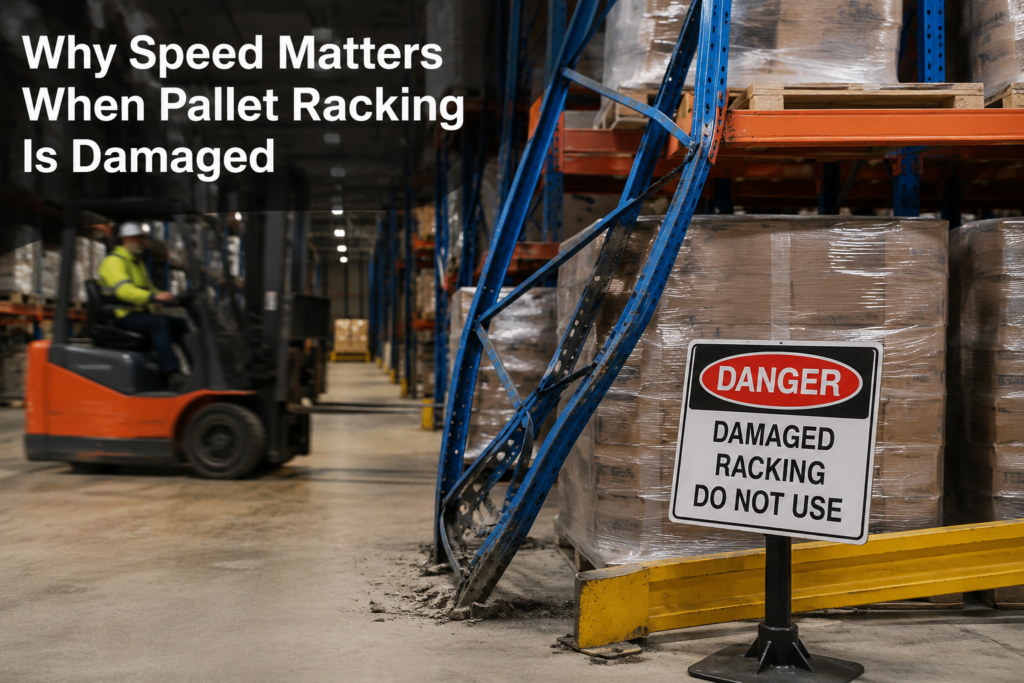

Delaying Repairs Can Cost More Than You Think
Warehouse operations rely on pallet racking being safe, stable and ready for use every day. When damage occurs, it is tempting to cordon off the affected area and continue working around it until there is time to arrange repairs. While this may seem like a practical short-term solution, it often creates bigger problems.
Taking storage locations out of use reduces warehouse capacity and can affect picking routes, stock organisation and vehicle movements. Employees may need to spend more time accessing products, while managers have to reorganise storage to keep operations running. If the damage becomes worse, the repair itself may become more complex and expensive.
Responding quickly helps avoid these issues and keeps disruption to a minimum.
The Benefits of Fast Racking Repairs
Investing in fast racking repairs allows businesses to restore damaged storage systems before they become a greater risk. Fast racking repairs help warehouses return to normal operations sooner, reduce the chance of additional structural damage and maintain a safe working environment for employees.
Repairing damage promptly also helps preserve the overall condition of the racking installation. When one damaged component is left in place, additional stress can be placed on surrounding sections of the structure. Addressing the issue early reduces the likelihood of further deterioration.
Companies such as DC Direct provide specialist repair services that are designed to minimise downtime while ensuring repairs are completed safely and professionally.
Damage Can Happen in Any Warehouse
Even warehouses with experienced forklift operators and good safety procedures experience occasional impacts. Modern warehouses are busy environments where vehicles, staff and stock are constantly moving.
Some of the most common causes of racking damage include:
- Forklift trucks striking uprights during loading or unloading
- Pallets being placed incorrectly onto beams
- Heavy loads exceeding the designed capacity
- Poor visibility in narrow aisles
- Repeated low-speed impacts over time
- General wear after years of daily use
Not every impact causes serious structural damage, but every incident should be assessed properly to determine if repairs are required.
Why Small Impacts Should Never Be Ignored
One of the biggest misconceptions is that only severe damage requires immediate attention.
In reality, even a small dent in an upright can reduce its ability to support weight. Steel loses strength when it becomes deformed, and repeated loading places additional pressure on already weakened components.
What appears to be cosmetic damage could affect the safety of the entire bay.
Regular inspections and prompt repairs allow these problems to be identified before they become much more serious.
Repairs Are Often More Practical Than Replacement
Many businesses assume damaged racking automatically means replacing complete frames or entire bays. In many situations, this simply is not necessary.
Modern repair systems allow damaged sections to be repaired while leaving the rest of the installation untouched. This approach offers several advantages.
It reduces disruption because less of the warehouse needs to be emptied.
It lowers costs by avoiding unnecessary replacement of undamaged components.
It also allows work to be completed much more quickly, helping warehouses regain full storage capacity sooner.
For businesses operating on tight schedules, these benefits can make a significant difference.
Supporting Warehouse Productivity
A well-maintained warehouse runs more efficiently. Employees can work safely, forklifts can move freely, and stock remains organised.
Damaged racking affects more than safety. It also impacts productivity by reducing available storage space and creating obstacles that slow daily operations.
Keeping repairs up to date helps businesses:
- Maximise storage capacity
- Reduce unnecessary downtime
- Improve stock accessibility
- Maintain efficient warehouse layouts
- Support smoother day-to-day operations
Looking after warehouse infrastructure should be viewed as part of maintaining overall business performance.
Meeting Health and Safety Responsibilities
UK employers have a legal duty to provide a safe working environment. This includes ensuring that pallet racking is inspected regularly and repaired whenever damage is identified.
Ignoring damaged racking can increase the likelihood of accidents and may leave businesses vulnerable if an incident occurs.
Combining regular inspections with prompt repairs demonstrates a proactive approach to warehouse safety and helps maintain compliance with recognised industry guidance.
Working with experienced providers such as DC Direct gives businesses confidence that repairs are carried out correctly and to a high standard.
Building a Preventative Maintenance Culture
The most effective warehouse maintenance strategies focus on prevention rather than reacting to problems after they become serious.
Encouraging staff to report impacts immediately, carrying out routine visual checks and arranging annual professional inspections all help identify issues early.
When repairs are completed quickly, businesses benefit from:
- Longer-lasting racking systems
- Lower maintenance costs
- Reduced operational disruption
- Improved workplace safety
- Better long-term return on investment
Preventative maintenance creates a safer and more reliable warehouse for everyone.
Final Thoughts
Damage to pallet racking is an inevitable part of running a busy warehouse, but allowing that damage to remain untreated does not have to be. Responding quickly reduces safety risks, protects valuable stock and helps maintain efficient operations.
Fast racking repairs are an effective way to restore damaged storage systems without unnecessary disruption. By acting promptly and working with experienced specialists such as DC Direct, UK businesses can protect their warehouse infrastructure, maintain compliance and keep operations running efficiently.